
Industry guide / Professional equipment
Help the buyer identify the right equipment before asking them to request a quote.
A surgeon looking by specialty and a technician looking for a known handpiece arrive with different questions. An equipment website needs to serve both. Our DGM and Tiroj work shows why discovery, product identity and the contents of an offer need separate attention.
Published 26 October 2026 · Real Company
Sources checked 25 October 2026. DGM is live client work; Tiroj is preparing for launch. Manufacturer pages are examples of information structure, not evidence of local stock or clinical suitability. No sales uplift is claimed.
01Two starting points
Some buyers know the task. Others know the model code.
One visitor arrives with a specialty or a work requirement. Another types an exact model because they already use the manufacturer's equipment. A third has a photograph and needs to identify the device. Putting all three through a long brand story makes product discovery depend on patience rather than knowledge.
Offer a direct model/brand route beside a route by relevant field or equipment family. Choose the categories from the real catalogue. A supplier with a few related devices may need a short, visible selection; a mixed catalogue may need search and a few dependable filters. The number of controls should follow the range, not a template.
This guide addresses website information and inquiry design. Product suitability, local availability and clinical claims require their own verified sources and responsible specialists. A website category is a navigation choice, not a recommendation to use a device for a particular patient.
02Our case / DGM, live
Specialty and model search lead into documented product pages.
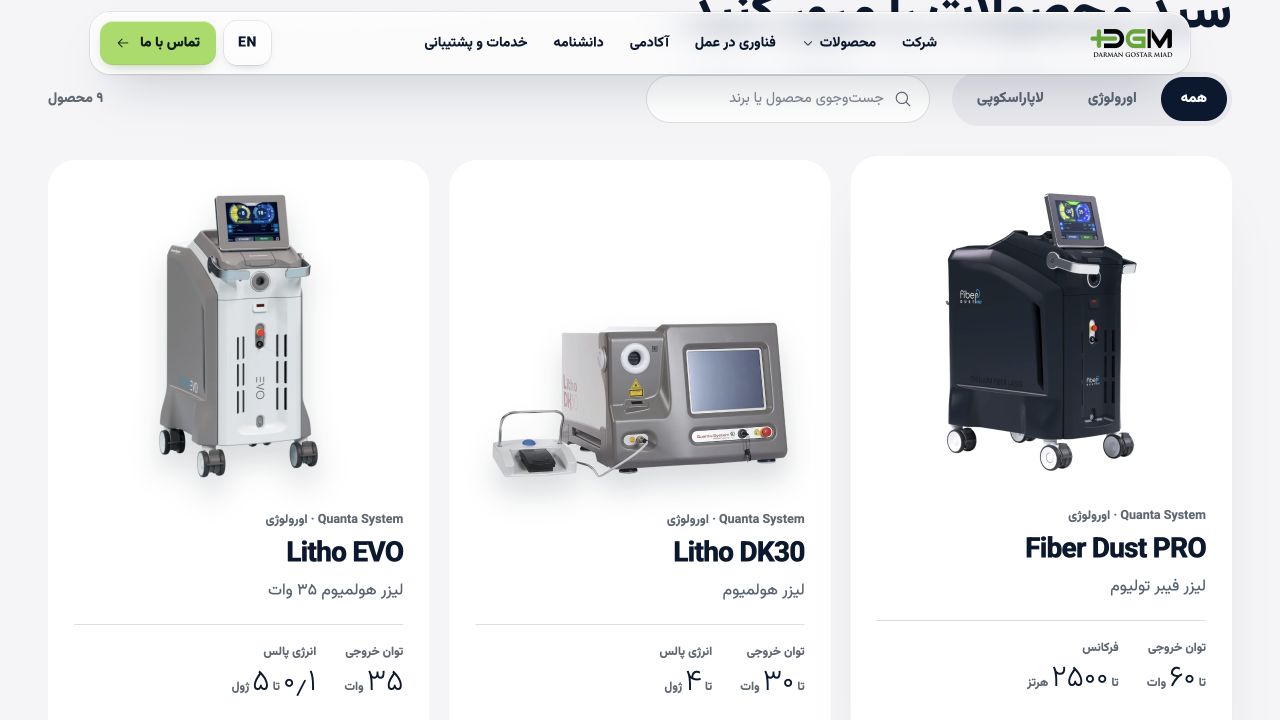
Darman Gostar Miad supplies medical laser and endoscopy equipment. In our live DGM work, the product directory provides specialty controls, model/brand search and individual product pages. During our inspection, visitors could browse Urology or Laparoscopy, or go directly to a named device. The homepage also provided routes to training, services and contact.
That creates a useful division of work: a field helps a visitor find the relevant part of the catalogue; a product page explains the exact model; a conversation resolves the buyer's actual request. A large product photograph helps recognition, while a readable model name and a clear link make it usable.
The screenshot below is a dated view of that delivered directory. It demonstrates information structure. It cannot establish whether the website increased sales, whether a device was in stock or whether a treatment claim is appropriate.
03A worked information example
A controller, a handpiece and a complete set are different records.
Imagine a laboratory buyer asking for a control unit they recognize. The request may mean the unit alone, a compatible handpiece or a configured set including a pedal. If the website uses one photo and one model label for all three, the inquiry begins with ambiguity. This is an illustrative buying scenario, not a customer quote or a claim about a particular package.
Keep manufacturer identity, model identity, package contents and commercial availability distinct. The following is a proposed data contract for the catalogue team. It leaves an explicit place for missing information instead of treating it as compatibility, absence or inclusion.
| Information layer | What it answers | What it must not imply |
|---|---|---|
| Manufacturer / brand / family | Who made it and which range it belongs to | A manufacturer logo proves local representation |
| Exact model / order code | Which device or version is being discussed | A similar-looking model is interchangeable |
| Configuration / compatibility | Which documented components can work together | Every compatible component is included |
| Included package | What this supplier is actually offering together | The photograph defines the complete shipment |
| Availability / quote state | What the supplier has confirmed commercially | A product appearing online is currently in stock |
| Source / revision | Where a fact came from and which version it describes | An old brochure proves the current local offer |
04Primary example / NSK
Show the package boundary beside the model.
NSK's ULTIMATE XL page distinguishes model and order codes and gives contents lists for configurations. It is a useful example of keeping the unit, handpiece and included items understandable. Its regional packages and electrical specifications are not automatically a distributor's local offer.
For your own catalogue, place the actual included items near the inquiry action. If the business has not confirmed the handpiece or package, say that it needs confirmation. A buyer should not have to infer inclusion from a promotional photograph or compare two unrelated specification blocks.
Write the data so it can be maintained. Give components their own names and sources; keep a clear relationship to the sellable package. A future editor should be able to correct an included item without redrawing the entire page.
05Our development case / Tiroj
Different professional fields need different explanations.
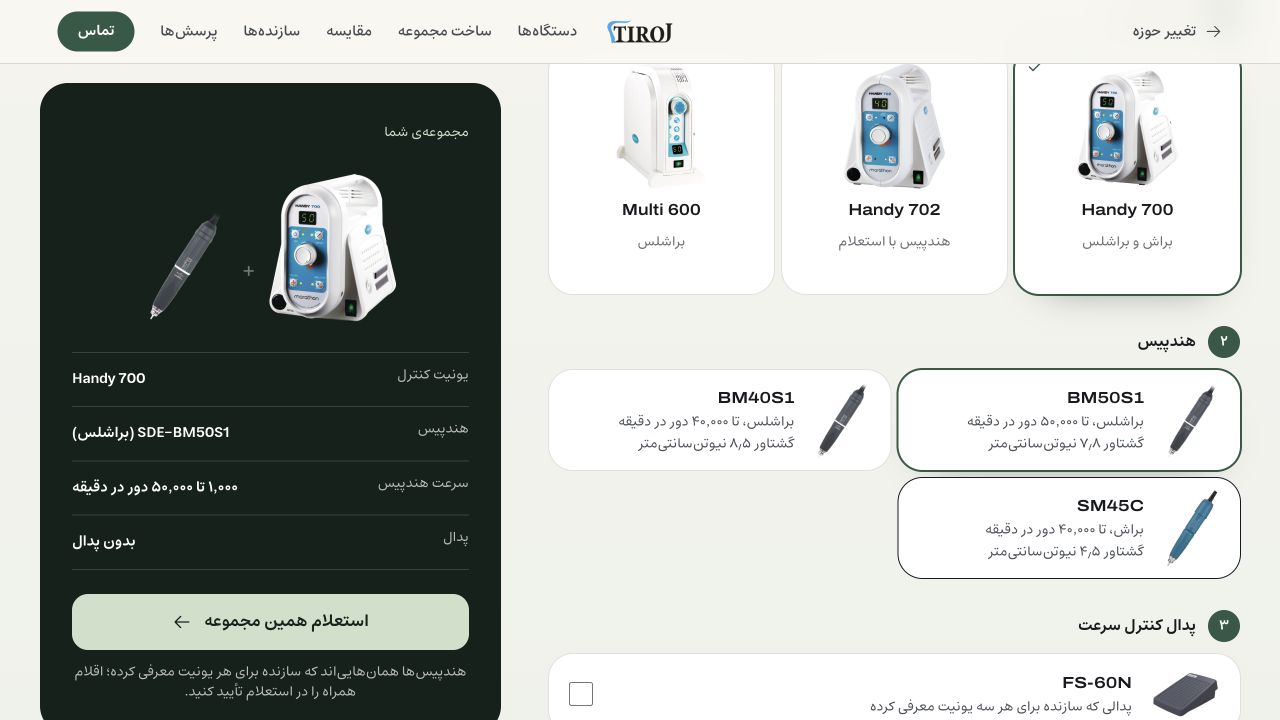
Tiroj is our equipment website and admin project, preparing for launch. Its catalogue work spans dental, laboratory and professional beauty equipment. The screenshot below was taken from our development build, not a production store.
In the implementation, product records distinguish field, maker, brand, model, source and availability. The laboratory builder separates control units, handpieces and a pedal, and displays a summary of the chosen set. In a direct development check, changing to a model whose handpiece was not confirmed cleared the handpiece choice and displayed an inquiry-needed state. The interface did not silently carry the previous combination across. This is an observed development behavior, not proof that a hardware combination is suitable.
The transferable principle is to match the explanation to the work. A known-model buyer needs direct access. A buyer comparing laboratory sets needs the component boundary. A professional comparing nail devices may need a different set of criteria. Sharing an admin or design language should not turn all those pages into the same essay.
06Specifications with a source
Compare equivalent information and leave uncertainty visible.
An equipment comparison is useful when the rows describe the same concept, unit and configuration. A control-unit measurement and a handpiece measurement should not appear to be competing values for the same part. An unknown specification should read as unconfirmed, not zero. Two devices with different jobs may need separate explanations rather than a winner.
Quanta System's Fiber Dust PRO page is a primary example of a named model with distinct technical feature categories. For a supplier, the useful practice is to connect each published fact to the exact model and appropriate document. The manufacturer's regional page does not confirm local stock, local package contents or the supplier's service obligations.
Set a simple review rule: record the source URL or document, model, revision when available and the person responsible for a correction. Keep manufacturer specifications separate from supplier-owned facts such as current availability. Do not translate marketing language into an unsupported promise of clinical benefit.
07Documentation and ownership
The buyer's questions continue after the quote.
A product page can lead to the relevant catalogue, manual, training contact and actual service route. KMT's catalogue library is a local example of organizing documents by field and brand. Renfert's service navigation separates repair/maintenance, manuals/spare parts and service partners. These are information-design examples; their presence does not establish document freshness or service quality.
For a small supplier, a clear product-linked document and a known support contact may be enough. A broad range may justify searchable documentation. In either case, a buyer should know whether they are reading a manufacturer manual, a supplier explanation or a commercial offer.
Make promises only where the business has confirmed them. Installation, training, spare parts and warranty can be important questions without becoming identical promises for every product. Describe what is available, what needs a quote and who can answer.
08The quote request
Carry the model into the inquiry and let the unsure buyer ask for help.
A selected model should remain visible when the inquiry opens. Carry its name or reference and any deliberate package choice into the request. Allow a clear change without wiping the buyer's message. Offer a separate route for someone who has not selected a model: describe the professional task and ask for help choosing.
A useful first reply often needs a reply route, the device or field and the purpose of the inquiry. More information may be needed later for a configured installation. Explain why it is needed rather than putting every possible sales question into the first form.
A prepared WhatsApp message is still waiting for the visitor to send it. An inquiry receipt confirms that a request was accepted, not that price or availability is guaranteed. Keep generic web inquiry forms free of patient records. Use explicit form labels and test whether selected context survives an error.
09Maintainable content
The admin is part of the catalogue's accuracy.
Ask the person who will maintain the range to add one device, correct a model name, update a source and change an availability state. If those changes require rebuilding an image containing the entire interface, or editing the same number in several language files, the design has created an accuracy problem.
Separate product photography from labels, specifications and inquiry controls. Choose clear responsibilities for manufacturer facts and local commercial facts. Where several fields show the same device, decide whether they share one product identity or deliberately separate offers, and make that relationship explicit.
On Persian pages, test a long Latin model code beside Persian labels and units. Make photographs recognizable on a narrow screen. Let a comparison table scroll inside its own region if needed; the whole page should not become wider than the phone. Essential details must remain available without waiting for an animation.
10A practical buying exercise
Ask a colleague to resolve one real product question.
The following proposed checks are useful acceptance tasks for an equipment website. They have not been run as a representative buyer study for this article. Use products and documents from your actual range and record where a buyer still has to call merely to identify what they are seeing.
- Find a known model directly, then find it again by its relevant field without relying on a model code.
- Explain which manufacturer, model and configuration the page describes.
- Identify the included items and one detail that still needs supplier confirmation.
- Compare related models using the same units and locate the source for a meaningful difference.
- Prepare a product-specific quote request, change the product and confirm the context stays understandable without sending a fake lead.
- Find the relevant manual or support route, then ask the editor to update one product fact.
11What to build first
A useful catalogue can earn its place before a checkout does.
For a supplier selling configured equipment through consultation, a focused first release can be a reliable catalogue, clear model/package information, linked documentation and a short inquiry. Checkout becomes useful when the business can maintain sellable configurations, confirmed pricing, stock and fulfillment. The appropriate choice depends on the actual sales process.
Measure whether inquiries contain enough context for a useful first reply. Keep product views, document use, contact clicks, received requests, qualified equipment conversations and proposals distinct. Ask sales staff which questions repeat because the website did not answer them. That can guide the next improvement even with modest traffic.
DGM provides live implementation evidence and Tiroj provides development evidence. Neither supplies a measured sales uplift in this article. The information contract and acceptance exercise are intended to be useful whether you work with us, another studio or your own team.
FAQ
Questions, answered.
Is this a guide to choosing medical equipment?
It is a guide to organizing a supplier website. Clinical suitability, compatibility, approved uses and local commercial terms need their own current evidence and responsible specialists.
Is Tiroj already live?
Our portfolio identifies Tiroj as preparing for launch. It is used here as a development case, not a claim of production use or customer outcomes.
Can medical and dental equipment share one website template?
They can share maintainable components. Their content, comparison criteria and inquiry context should follow the actual equipment and buyer questions. A specialist guide deserves its own URL only when it provides substantial distinct information.
Start a project
Planning an equipment catalogue?
Send a few representative products and explain how quotes work today. We can identify the content and operating decisions the website needs.
Usually replies the same day.